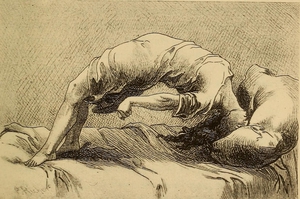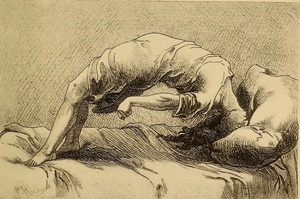
In daily life, hysteria is most often either an adjective used to describe a passing emotional state or a disease confidently placed in the past. The historical phenomenon of hysteria is, however, much more complex and undecided than that. It is enigmatic, elusive, and continuously adapted. Additionally, the history of hysteria has a scope far beyond the history of medical science, and touches upon a number of fields. However, the social and cultural history of hysteria, along with its medical counterpart, emphasizes the one thing that remains certain about the phenomenon – its unrelenting insistence upon women.
It is widely known that hysteria has been closely connected to women’s health throughout history. The historic relationship between the two seems almost symbiotic. Yet, fully realizing the connection is not so simple. Hysteria itself has in fact never had an agreed upon definition, and continues to be in a state of flux.[1] Its history is filled with layers and layers of context. Therefore, to understand its relationship with women, I will first attempt to present an understanding of the phenomenon itself. In many ways, the history of hysteria is a history of women. By shaping my structure to match the chronological history of hysteria’s development, I intend to analyze the historical and historiographical factors that shape its relationship with women and the wider world.
In many ways, the history of hysteria is a history of women.
The social structures that contributed to shaping the medical history of hysteria peek through in the literature, but are rarely the focal point of serious investigation. Most articles I have come across on the subject tend to categorize the development of the disease by geographic area, time period, or treatments, with the main social and cultural discussion being the medical traditions exchanged between the men treating the patients.[2] Questions of social roles and cultural contexts are seldom brought up. An exception to that observation would be the extensively detailed medical article “Women and hysteria in the history of mental health,” which presents explanations for hysteria as specifically real or imagined, based on scientific or magic-demonological visions.[3] Categorizing explanations for hysteria by way of separating the medical or scientific from the superstitious or magical emphasizes the social and cultural contexts in which the explanations were created and upheld. These approaches are used to explain the role of environmental factors in how women have historically been viewed as vulnerable to mental disorders in general and hysteria in particular.[4] The article helpfully ties explanations for hysteria to historical contexts of women’s roles in society, but still leaves a lot of potential for further exploration. Altogether it presents the same information about hysteria’s historical existences and developments.
Hysteria Throughout History
Hysteria has existed as a defined concept for thousands of years, and similar descriptions even longer. It has been visualized across civilizations, time, philosophy and literature.[5] From ancient Egyptian papyrus to the American Psychiatric Association’s Manual of Mental Disorders, hysteria exists everywhere and nowhere.[6] The Kahun Papyrus and Eber Papurys, from 1900 and 1600 BC respectively, describe hysteria as symptoms caused by a wandering uterus.[7] The recommended treatment was placing scented substances near the mouth, nose and vagina in order to draw the uterus back to its correct place in the body, and its cause was spiritual or magical afflictions.[8] The uterus continued being the perceived root of the problem for thousands of years, while the symptoms and remedies shifted time and again.
It is widely perceived that Hippocrates coined the term hysteria and formulated the wandering uterus in his fourth century BC Corpus Hippocraticum.[9] The word itself is derived from the Greek word for uterus. Helen King, one of the most prominent scholars in the field of hysteria and its historiography, has long been questioning the validity of the origin of the definition of hysteria.[10] In her work on the origin of the phenomenon, she challenged historians such as Ilza Veith on both Hippocrates’ creation of the definition and his application of the term by pointing out the over-simplification and blind following of an established historical truth.[11] She deemed a revision of the historians’ understanding long overdue. Challenging the perceived origins of such a famous conundrum as hysteria seems to me as a symbolic gesture for its entire history – particularly the social and cultural elements that contributed to its definitions and explanations. Furthermore, the uphill battle that is women’s history has no lack of determined ‘truths’ about women’s bodies and role in society to contend with.
Despite its questionable validity, the story of how hysteria was understood and treated in ancient Greece brings forth an important topic in the wider history: the connection between women, sexuality, and illness. While the wandering uterus remained relevant for a long period, the supposed sexual nature of hysteria bore social connotations that seem to have become permanent in the collective understanding. The idea arose in ancient Greece of female madness being directly related to an “abnormal” sexual life; Plato even goes so far as to say the uterus is “sad and unfortunate when it does not join with the male.”[12] Other causes were hypothesized as being poisonous humors that could not get expelled from the uterus due to an inadequate sexual life, or that the woman’s body is simply too cold and wet to avoid “putrefaction of the humors.”[13] Sexual gratification could and should only be acquired through marriage, placing single and widowed women at a higher risk of a “bad” uterus.[14] The role of desire in the decided relationship between women and hysteria only continued to grow with time, and the connection between shame and sexuality flourished in the diagnosis.
Hysteria is a category of neurosis, a sensationalist and erotically charged mystery, a cultural legend, a set of medical traditions, a basis for the history of many discoveries within modern psychiatry, completely made up, and decidedly real
Jumping forward to the Middle Ages, sexual desire, women, and mental illness all coalesce in the manifestation of the Devil; a demonic presence takes hold in the sinful woman because she is so much more susceptible to hysteria and melancholy than the man.[15] Women’s sexuality could in turn be directly tied to evil witches and demons because any connection to hysteria was a connection to sin and weakness. The popular fear of witches even had a hand in the development of the “misogynistic crusade” of the Middle Ages; by valuing chastity and viewing hysteria as women’s lack thereof, their inferiority was determined.[16] This demonological vision of hysteria is abruptly changed by the likes of Descartes and Willis, who in the 17th century began to explore the possibility of hysteria being linked to the brain and the nervous system rather than the soul or something inexplicable and insidious.[17] The “uterine fury” that characterized hysteria slowly faded away with new studies on emotions and the connection between the mind and the body.[18]
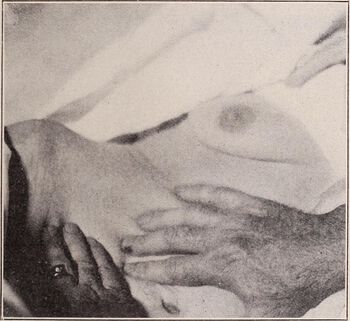
While hysteria was no longer accredited to the sexual frustration of the uterus with the appearance of the study of neurology, peculiar treatments meant to relieve emotional stress through sexual acts nonetheless persisted. The birth of psychoanalysis did little to discredit theories of the connection between female sexuality and hysteria. In fact, until the 20th century, the medical treatment known as “uterine massage” was practiced actively and viewed as scientifically accurate.[19] Initially invented by a Swedish Army Major, the treatment was seen as effective for almost any kind of gynecological issue. By providing internal and external massage to the patient, doctors in one of the many clinics that provided the service would essentially bring women to orgasm and claim it would heal their anxious state.[20] The practice of gynecological massages led to the invention of stimulation devices such as vibrators, as the sessions were “long and physically exhausting” for the physicians doing the work.[21] While this small aspect of women’s history of hysteria might appear more humorous than the rest, it is nonetheless a reminder of society’s need to quell the needs and feelings of women, even under the guise of a medical treatment. The sentiment is further darkened when including the detail that physicians could purposefully inflict pain onto the patient during these treatments in order to insure it was not pleasurable.[22] Even when the treatment for hysteria was meant to feel good, the need to ensure that women had little sexual freedom persisted.
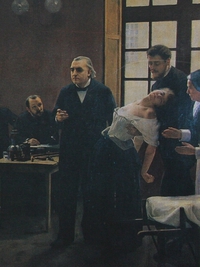
Jean Martin Charcot’s groundbreaking studies on hysteria and neurology in late 19th century France revealed the disease was in fact more common in men, yet people did not stop attributing it to women.[23] This was largely due to the fact that women’s connection to the disease was a social and cultural given and would naturally have to continue to be studied. One of the most famous figures in psychoanalysis, Sigmund Freud, who was a medical student under Charcot and heavily influenced by his ideas on hysteria, made his contribution to the field by crediting its origin to women’s despair and psychological trauma over a lack of a penis. The obvious lack of representation for women in the history of hysteria’s medical development seems only ironic, but society’s insistence on the woman’s destined connection to hysteria shaped an unforgiving cultural landscape of men attempting to solve the mysterious woman.[24]
Conclusion
Hysteria is a category of neurosis, a sensationalist and erotically charged mystery, a cultural legend, a set of medical traditions, a basis for the history of many discoveries within modern psychiatry, completely made up, and decidedly real.[25] As a topic of social roles and expectations, hysteria is to me symbolic of humanity itself – including the gender roles that have permeated so much of human history. Without much of a say in the matter, women became and have remained at the center of hysteria in both popular culture and the scholarly world. The entanglement of sexuality, shame, and bodily mystery only fueled the need to place hysteria at the woman’s core. My note of the similarities between countless historical articles on hysteria is not necessarily a critique; its mysterious and fascinating nature is entertaining to read about both in popular culture and in academia, and it is easy to recognize an eagerness to describe and break down its peculiar life cycles. Deconstructing hysteria’s history seems to be an endless task.
While the disease was officially removed from the American Psychiatric Association’s Manual of Mental Disorders in 1980, it did not disappear.[26] From a medical perspective, the name and description were simply adapted to reflect modern perspectives of neurology and mental illnesses a little better, while the cultural expectation of women having a certain rash relationship with their emotions did not magically vanish 45 years ago. The ability to approach the topic from a number of different angles makes it complex and difficult to encompass, but there is not a lack of effort made to do so. Conclusions on the ever-lasting shroud of mystery that hysteria is wrapped in, however, are divided and ever-changing. The historiography on hysteria is in agreement on one thing, though – it is a history that deeply reflects the conditions of humanity itself.
Notes
[1] M. Trimble & E.H. Reynold, “A Brief History of Hysteria, From the Ancient to the Modern,” in Handbook of Clinical Neurology, ed. Mark Hallett, Jon Stone & Alan Carson (Elsevier, 2016), 9.
[2] Helen King, “Once Upon a text: Hysteria from Hippocrates,” in Hysteria Beyond Freud, ed. Gilman, Sander L., Helen King, Roy Porter, G. S. Rousseau, and Elaine Showalter (University of California Press, 1993), 4.
[3] C. Tasca, M. Rapetti. M.G. Carta & B. Fadda, “Women and Hysteria in the History of Mental Health,” Clinical Practice and Epidemiology in Mental Health no. 8 (2012), 110.
[4] Tasca, et al., “Women and Hysteria,” 110-11.
[5] Siddharth A. Shetty, S. Chandini, Sharol Lionel Fernandes & A. T. Safeekh, “Hysteria: A Historical Perspective,” Archives of Medicine and Health Sciences 8, no. 2 (2020), 312.
[6] Ada McVean, “The History of Hysteria,” McGill Office for Science and Society, July 31, 2017, https://www.mcgill.ca/oss/article/history-quackery/history-hysteria.
[7] Shetty, et. Al., “Hysteria: A Historical Perspective,” 312.
[8] Shetty, “Hysteria,” 312.
[9] Shetty, “Hysteria,” 312.
[10] King, “Once Upon a Text,” 4-5
[11] King, “Once Upon a Text,” 4-5
[12] Tasca et. al., “Women and hysteria in the history of mental health,” 110-11.
[13] Tasca et. al., “Women and hysteria,” 110-11.
[14] Tasca et. al., “Women and hysteria,” 110-11.
[15] Tasca et. al., “Women and hysteria,” 113.
[16] Tasca et. al., “Women and hysteria,” 114.
[17] Tasca et. al., “Women and hysteria,” 114
[18] Shetty, “Hysteria: A Historical Perspective,” 313.
[19] McVean, “The History of Hysteria.”
[20] McVean, “The History of Hysteria.”
[21] McVean, “The History of Hysteria.”
[22] McVean, “The History of Hysteria.”
[23] McVean, “The History of Hysteria.”
[24] McVean, “The History of Hysteria.”
[25] M. S. Micale, “Hysteria and its Historiography: A Review of Past and Present Writings,” History of Science 27, no. 3 (1989), 1.
[26] McVean, “The History of Hysteria.”
Bibliography
King, Helen. “Once upon a Text: Hysteria from Hippocrates.” In Hysteria Beyond Freud. Edited by Gilman, Sander L., Helen King, Roy Porter, G. S. Rousseau, and Elaine Showalter. University of California Press, 1993
McVean, Ada. “The History of Hysteria.” McGill Office for Science and Society, July 31, 2017. https://www.mcgill.ca/oss/article/history-quackery/history-hysteria.
Micale, M. S. “Hysteria and its Historiography: A Review of Past and Present Writings.” History of Science 27, no. 3 (1989): 223-261.
Shetty, Siddharth A., S. Chandini, Sharol Lionel Fernandes, and A. T. Safeekh. “Hysteria: A Historical Perspective.” Archives of Medicine and Health Sciences 8, no. 2 (2020): 312-315.
Tasca C, M. Rapetti, MG. Carta and B. Fadda. “Women and hysteria in the history of mental health.” Clin Pract Epidemiol Mental Health 8 (2012): 110-119.
Trimble, M. and Reynold, E.H. “A Brief History of Hysteria, from the ancient to the modern.” In Handbook of Clinical Neurology. Edited by Mark Hallett, Jon Stone and Alan Carson. Elsevier, 2016.