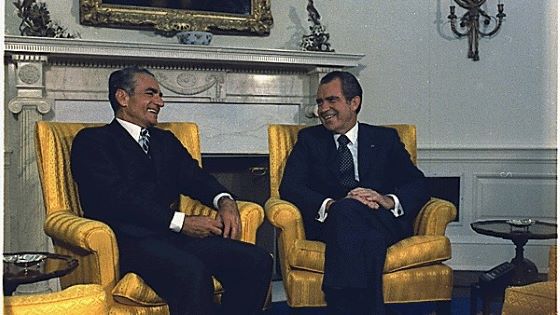
“We do urge that we do all we can to respond as favorably as possible wherever we can, particularly since there seems to be a general agreement that after 1971 the future stability and security of free world interests in Gulf … will almost inevitably depend to very considerable extent on Iran”[1]
Doulgas MacArthur, American Ambassador to Iran
It has been commonplace among scholars of US-Iranian relations to state that Iran held a special place in US foreign policy during the presidency of Richard Nixon. Scholars have since the early 1980s shown that Iran was the predominant US ally in the Persian Gulf region, usually centering on the 1972 Tehran Summit where Nixon gave the Shah his so-called “blank cheque” for Iranian arms purchases.[2] Another common aspect among these scholars has been to criticize the concept of the “Twin Pillars” strategy, intent on balancing Persian Gulf security on its two largest states: Iran and Saudi Arabia. The term was originally coined by journalists to explain US policy towards the Persian Gulf prior to the Iranian Revolution.[3] Ever since, most scholars have mainly dismissed that the idea held sway within the administration, either pointing out that Saudi Arabia was incapable of playing a role similar to that of Iran, that it was a fig leaf policy intent on not offending the Arab states, or that Israel, rather than Saudi Arabia, constituted the “true” second pillar.[4] Yet few of these scholars have examined US policymaking towards the Persian Gulf as a whole. Most of the works focusing on the area are mainly steeped in documents relating to the US-Iranian relationship, and very few incorporate documents covering the US relations with other actors in the area.
How and why did Iran gain such a prominent position in American foreign policy during the Nixon administration? How did this affect Washington’s relationship with Iran’s neighboring states? In this essay I will look closer at how Iran became an institutionalized feature in American foreign policy towards the Middle East and the Persian Gulf during the Nixon administration. I will argue that the Nixon administration’s view of Iran as their key ally in the region heavily shaped their policy formulations towards the rest of the Gulf. I will start by explaining how this notion developed within the administration before I will give a short overview over how the Nixon administration approached the negotiations between Britain, Iran, and the two sheikdoms of Ras al-Khaimah and Sharjah as a showcase for how the US deferred to Iran in regional matters.
Hijacking the Nixon Doctrine.
Through the first two decades of the Cold War, Washington had mainly sought to stabilize rather than strengthen Iran. As Stephen McGlinchey has argued, the common wisdom in Washington since the Truman administration was to limit arms sales to a level that would not hurt the Iranian economy. Washington became more forthcoming and generous in their armament grants during the mid-sixties, as Iran’s oil revenue rose, and Washington’s attention centered on Vietnam.[5] Even so, the Johnson administration still sought to limit the arms sales to a level that would not harm the Iranian economy. While Iran remained an important bulwark against the Soviet Union, Great Britain was Washington’s main partner in keeping stability and containing radical influences in the Persian Gulf.[6]
Yet this consensus started to change with the arrival of Richard Nixon in the White House in 1969. Nixon came into office with an ambitious program to reform American foreign policy into what he called “the new structure for peace”. As the world was changing during the 1960s, Nixon concluded that the kind of “bear any burden”-commitments that had characterized the foreign policies of John F. Kennedy and Lyndon B. Johnson was out of touch with the American public and the altering balance of power in the world. Nixon would rather seek to better hone American power and rebuild the Cold War consensus at home by improving relations with Moscow and Beijing to stabilize the international order and to transfer the role of regional defense to local allies. The latter aspect became known as the “Nixon Doctrine”, which, according to Paul Thomas Chamberlin, sought to transfer the responsibility of regional defense to local allies, through an infusion of American arms and economic aid.[7] In the words of Odd Arne Westad, Nixon sought to transform America’s global role into “an overseer, not intervener”.[8]
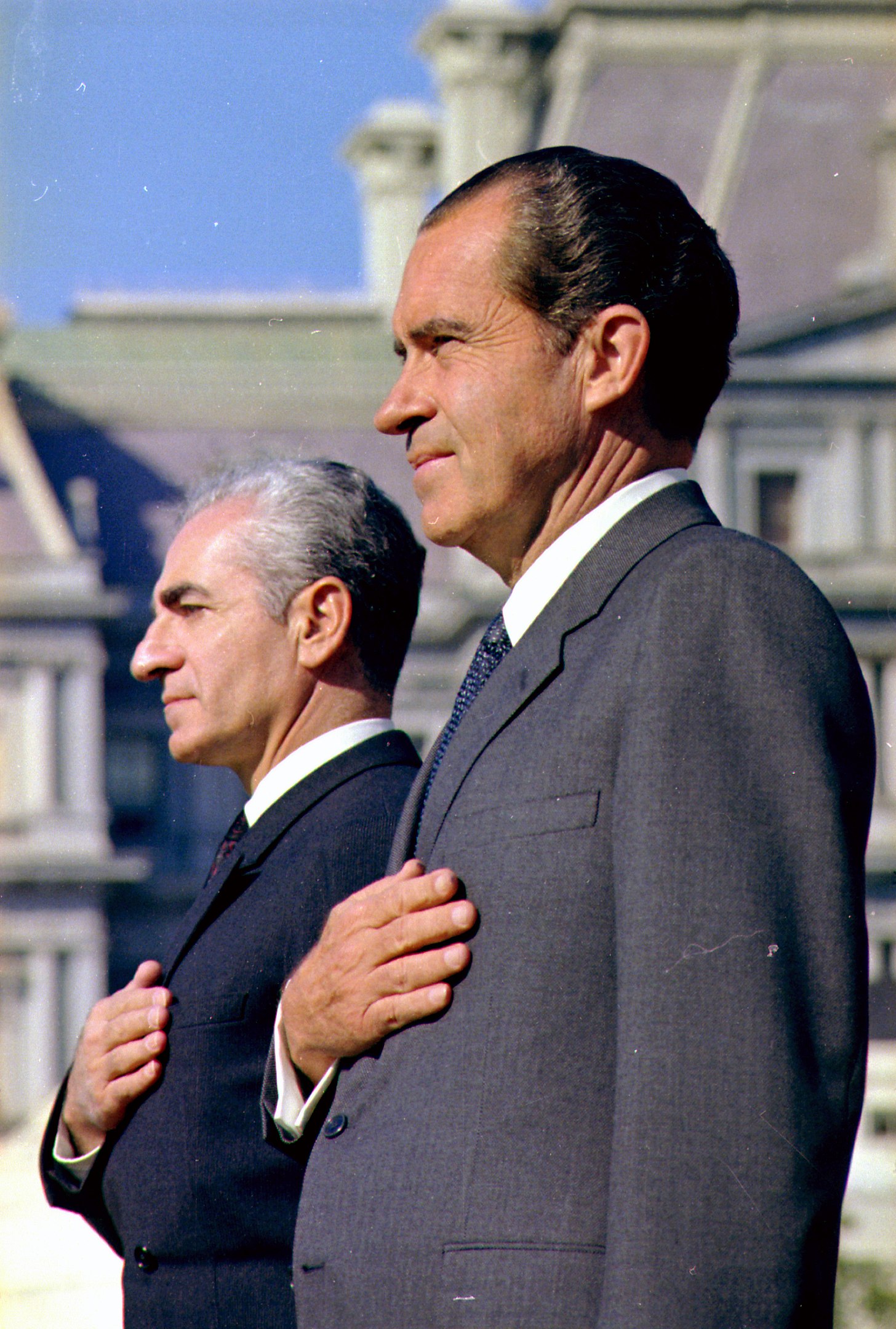
Credit: Robert L. Knudsen
Wikimedia Commons.
Nixon would rather seek to better hone American power and rebuild the Cold War consensus at home by improving relations with Moscow and Beijing to stabilize the international order and to transfer the role of regional defense to local allies.
The Nixon Doctrine suited the Shah’s regional ambitions well. He had long advocated for a more prominent role for his country in the Persian Gulf, which grew even more insistent after London announced in early 1968 that it would end its military commitments to the Persian Gulf by the end of 1971.[9] As Washington had relied on Britain to provide security and stability in the region since the beginning of the Cold War, the Nixon administration required a new strategy for handling the future of the Gulf. Yet with more pressing global issues to attend to, the policy deliberations moved ahead slowly, with no formal policy being adopted before November 1970.[10]
Even while Washington operated without a formal policy towards the Persian Gulf, the Nixon administration moved slowly towards accepting Iranian primacy in the region. Roham Alvandi attributes this to a changing view of the Shah within the administration. Rather than viewing the Shah as a megalomaniac with a vulnerable ego, as had been common in earlier administrations, Nixon admired the Iranian monarch, referring to him as America’s “one friend” in the area.[11] Henry Kissinger, Nixon’ national security advisor, also developed an admiration for the Shah, enjoying exchanging strategic views with him.[12]
This view was in no small part helped by the Shah’s own activism in presenting his strategic visions to American officials. As Alvandi has shown, the Shah effectively employed the language of the Nixon Doctrine in explaining his views on future security in the Gulf, presenting his own vision for Iranian primacy as the Nixon Doctrine.[13] By pointing to the growing relationship between Iraq and the Soviet Union, the Shah utilized Cold War language to argue that Moscow’s influence in the region was growing and that Iran was the sole actor capable of handling this threat. Yet the Shah argued that this could only be achieved by increasing arms sales to Tehran. Alvandi points out that many American officials questioned the Shah’s strategic assessments, in part pointing out that Iran’s strength dwarfed the Iraqi. Furthermore, one pointed out that the Soviet Union wanted a stable relationship with Iran and had little interest in Iraq confronting Tehran. Even so, the Nixon administration was concerned with the developments, because they were, as Alvandi states, “looking at the Gulf through the Shah’s eyes”.[14]
The growing acceptance for the Shah’s strategic vision of the Gulf among American officials was fueled by an underlying assumption about Iran’s future importance within the administration. Officials like Kissinger, Douglas MacArthur, the US ambassador to Tehran, and others advocated for and adopted pro-Iranian measures, like expanding the arms credits granted by the Johnson administration, despite the lack of a formal policy. Mari Salberg has argued that many members of the Nixon administration had come to believe that Iran would become America’s key partner in the region for years to come. This in turn led to an interpretation of how the unfinished Gulf policy would look like, moving US’s day-to-day policy increasingly in a pro-Iranian direction and reducing the room for maneuver for alternative policies.[15]
As a result, when the Persian Gulf policy was finally formalized through National Security Decision Memorandum 92 (NSDM 92) in late 1970, no major changes actually occurred. While the administration stressed the importance of promoting Saudi-Iranian cooperation, they also underscored the “preponderance of Iranian power” in the region.[16] By and large, most scholars read the NSDM 92 as an adaptation of Iran as the Nixon administration’s chosen instrument in the Persian Gulf. What Salberg has shown is that the underlying assumptions of the Nixon administration helped institutionalize Iran’s place as the chosen instrument.[17]
In the interests of Gulf security.
Much of the scholarship that explores the Nixon administration’s proclivity for Iran and its assumed importance, tends to focus on the administration’s forthcomingness in oil and arms agreements, often concluding with the Tehran Summit in the summer of 1972. Yet, as several scholars have pointed out, the Nixon administration’s views on Iran meant that its Iran policy became its Persian Gulf policy. This had a clear impact on Washington’s relations with the Arab states in the region, as Washington pursued a policy more in line with Iranian interests than its own, potentially causing harm to the security of other important allies like Saudi Arabia.
An example of this is the US’s approach towards the negotiations between Britain and Iran over the Gulf islands of Abu Musa and the two Tunbs. As Britain was preparing to withdraw from the region by the end of 1971, it was attempting to tie up loose ends that would leave the Gulf stable after its departure. The two most central aspects of this effort were the negotiation over a potential federation among the so-called Trucial States[18], a group of nine sheikdoms under British protection, and resolving the dispute over the Gulf islands between Iran and the two Trucial States of Sharjah and Ras al-Khaimah. The Shah claimed the islands both on historical pride, claiming they had been stolen from Iran by Britain in the late nineteenth century, and on security, considering their proximity to the Strait of Hormuz.
Washington, wanting to foster Arab-Iranian cooperation as a foundation for future stability, followed the negotiations closely. As the negotiations had failed to move in any direction by the start of 1971, officials in Washington started to fear that the lack of a resolution could result in a confrontation between Iran and the two sheikdoms. The Shah had issued several threats to invade the islands if Britain did not hand them over to him. Furthermore, while he had initially offered support for the formation of a federation among the Trucial States, he had begun to make this support conditional on resolving the islands dispute in his favor. For the sheikdoms the problem, as William Luce, the chief British negotiator, explained to his American counterparts in early 1971, was the Shah’s insistence on Iranian sovereignty over the islands. The rulers of Sharjah and Ras al-Khaimah feared handing over “Arab land” to Iran could create domestic backlash that could threaten their regimes.[19]
These fears were echoed by Arab littorals themselves. Already in 1970, Kuwaiti officials had warned the US that an Iranian invasion of Abu Musa would alienate the Gulf Arabs from Tehran and make future Arab-Iranian cooperation impossible.[20] The American Consulate in Dharan had been repeatedly warned that an invasion would likely cause uprisings in Sharjah and Ras al-Khaimah, threatening the ruling families there.[21] The ruler of Sharjah, Sheik Khalid, even told the US consul, Lee Dinsmore, that handing over Abu Musa could lead to assassination attempts against him.[22] Dinsmore found these statements troubling, as both Dubai and Sharjah would probably look to Iran for protection following the British withdrawal. If Iran opted for an invasion, Dinsmore believed that Iran would seriously damage its relationships with the Gulf littorals, ruining the current cordial ties that Tehran enjoyed with some of them.[23]
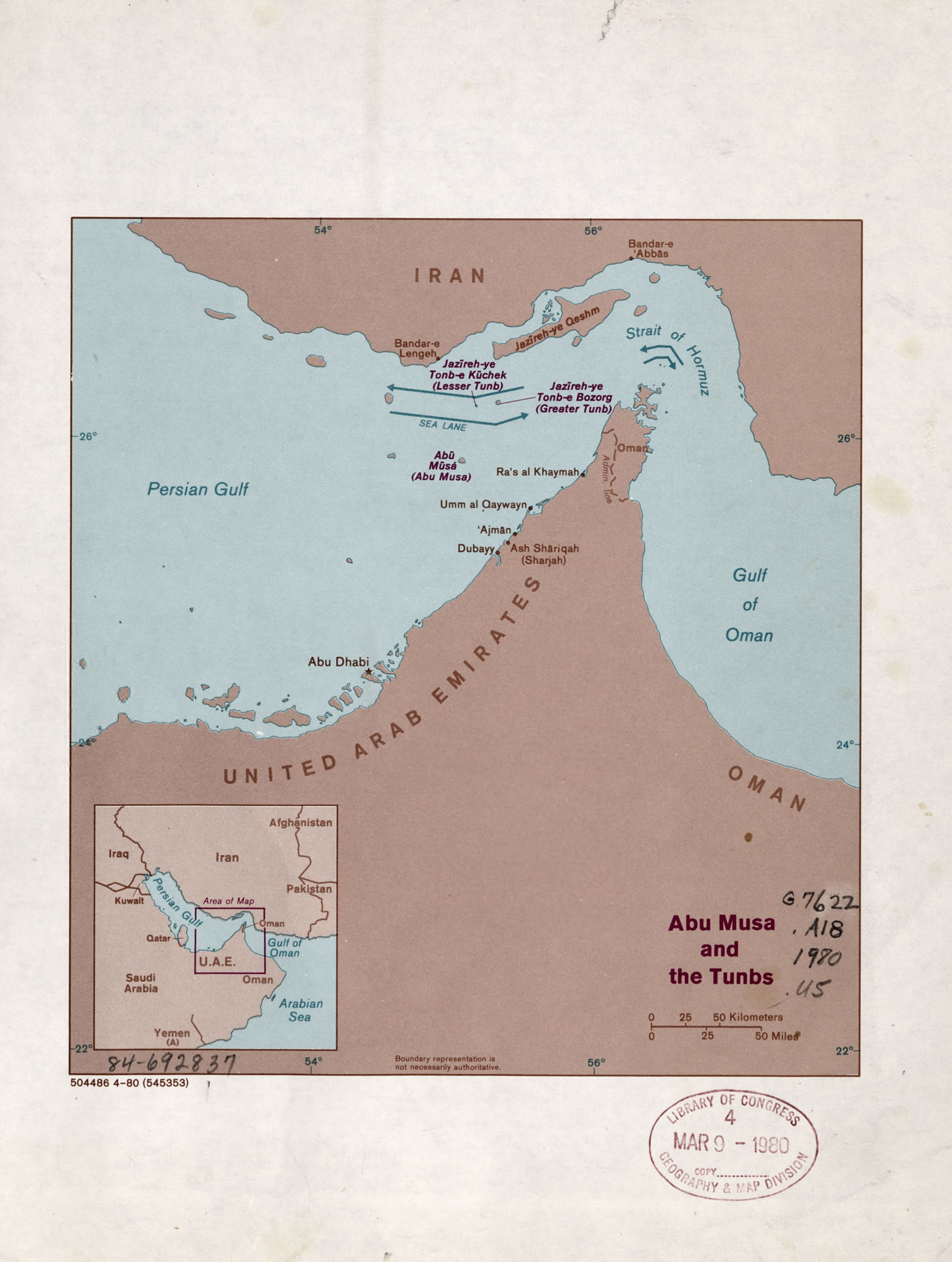
Credit: United States. Central Intelligence Agency.
Wikimedia Commons.
The US State Department considered various ways they could attempt to make the Shah more accepting of a diplomatic solution and supporting the future federation. Ambassador MacArthur poured cold water on this suggestion. He argued that the Shah’s adamant position made him opposed to any form of compromise over the federation. The Shah, MacArthur explained, knew that Saudi Arabia, Abu Dhabi, Dubai, and Bahrain would likely look the other way in the event of an Iranian invasion. If a federation was formed prior to such an event, Sharjah or Ras al-Khaimah could use their position within the federation to make the other members involved in the dispute. Finding a solution that would make the Shah give up the islands was impossible, as MacArthur explained to the British Foreign Secretary, since the Shah felt about the islands the same way the US felt about Soviet missiles on Cuba.[24]
MacArthur, mostly echoing the reasoning the Shah himself presented, continually advocated for a pro-Iranian solution to the dispute. He explained that the Shah viewed Washington’s position towards the negotiations as a test of the Nixon Doctrine, arguing that supporting a British-sponsored solution unacceptable to the Shah would damage Washington’s relationship with him. Since many of the Gulf states already looked to Iran for protection after the British departure and Iran being the sole option to uphold stability, it would be unwise for Washington to support a solution that would result in a confrontation. Rather, MacArthur argued, Washington ought to pressure Britain into sponsoring a package deal where the two sheikdoms would give the islands to Iran in return for some financial compensations. [25]
Finding a solution that would make the Shah give up the islands was impossible, as MacArthur explained to the British Foreign Secretary, since the Shah felt about the islands the same way the US felt about Soviet missiles on Cuba.
Over the span of August and September 1971, Britain and Iran moved closer to an agreement.[26] Yet news of the agreement was followed by a warning from the Shah. The Shah, through MacArthur, warned that Iran had gone as far as it could with the new proposals and if Britain was unable to convince the sheiks, it would seriously damage the UK-Iranian relationship and end the prospect of further negotiations over the islands. MacArthur strongly urged Washington to pressure London into getting the sheiks’ agreement.[27]
The warning created a sense of urgency in Washington. In the National Security Council, Harold Saunders wondered whether to leave the negotiations alone or to engage the US more directly if the sheiks responded negatively.[28] Assistant Secretary of State, Joseph Sisco urged the Secretary of State William Rogers to communicate to London that Washington wanted the sheiks to agree to the Shah’s terms, which Rogers did.[29] At this critical junction, future cooperation and stability in the region was at risk, Sisco argued. The Shah’s most recent threats to denounce the proposed federation, something Iran had so far refrained from doing, and to invade the islands if a solution was not forthcoming, created the sense that the negotiations had reached a point where they could break down completely if the Sheiks rejected the new terms.[30]
On the whole, the response within the administration followed Salberg’s argument about the underlying assumption about the future importance of Iran for the region as a driver for US policy. As the Shah became more violent in his threats to invade the islands and undermine the future federation, the Nixon administration increasingly accepted his intransigence position in the negotiations. Rather than pressure the Shah to adopt a softer position, Washington wanted Britain to do more to make the sheiks accept the Shah’s demands. In order to avoid a confrontation between Iran and the two sheikdoms that would do irreparable damage to Gulf stability, the Nixon administration adopted and advocated the Shah’s own terms for future cooperation among the Gulf littorals. This in turn meant sacrificing the position of its other key ally in the region, Britain.
In order to avoid a confrontation between Iran and the two sheikdoms that would do irreparable damage to Gulf stability, the Nixon administration adopted and advocated the Shah’s own terms for future cooperation among the Gulf littorals.
The Shah’s threats were received differently in London. Sensing that the Shah was seeking a compromise, London developed a formula where they offered to be acquiescent on the Shah’s claims to the Tunbs if he was more forthcoming on Abu Musa. This resulted in an agreement, concluded a mere two weeks before the British departure, where Iran and Sharjah would in effect divide the island.[31] The final agreement more or less resembled solutions Britain had advocated since the beginning of the negotiations, but with the difference that the Shah kept his claim to Abu Musa. In essence, London had managed to negotiate a compromise acceptable to both the Shah and Sharjah. The Shah gained diplomatic legitimacy in establishing military presence on the Gulf islands, while Britain, through Sharjah’s acceptance, could retain their influence among their protected states.[32]
The Memorandum of Understanding between Sharjah and Iran was welcomed news in Washington. The Nixon administration were content with the fact that Britain had managed to negotiate a solution that allowed Arab-Iranian cooperation to continue, making it possible for the Shah to fulfill his role as the new protector of the Gulf with, at least in theory, the Arab littorals’ acquiescence.[33]
Simultaneously, officials noted that Britain had decided to simply accept Iran invading the Tunbs against the will of Ras al-Khaimah. The sheikdom had, as MacArthur noted, refused to engage seriously in the negotiations with the Shah, outright rejecting a similar agreement for the Tunbs as Sharjah had for Abu Musa.[34] In fact, Sheik Khalid of Ras al-Khaimah had traveled to Washington to garner support for Ras al-Khaimah’s independence and claims to the Tunbs.[35] The Nixon administration refuted Sheik Khalid’s outreach, urging the Sheik to quit his attempts of becoming independent and join the United Arab Emirates. The administration explained that the US viewed cooperation among the Gulf states as the key to a future stability and security in the region.[36]
Credit: Unknown.
Wikimedia Commons.
On the morning of November 30, the day the British protection treaties expired, Iranian troops landed on the three Gulf islands. The news sparked outrage among the Arab states. Even so, the news was received calmly in Washington. The State Department reported that the diplomatic reactions had been fairly mild. Among the Western aligned Arab states, only Kuwait had publicly denounced the invasion, but refrained from making any further moves. Saudi Arabia ignored the development.[37] In all, Secretary of State William Rogers was pleased with the result. The agreements Britain had managed to secure, particularly with Iran, had allowed London to withdraw from the region peacefully. As such, Britain could continue to work with the US to influence the region towards stability in the uncertainty following the transition.[38]
Conclusion.
The growing acceptance within the Nixon administration that Iran would come to play an important part in protecting American interests in the Persian Gulf in the future moved the administration towards adopting Iran as their chosen instrument in the Persian Gulf. This in turn had a significant effect on Washington’s policy towards the other states in the Gulf, often deferring to Iran’s interests when formulating policy towards the region.
In this article I have explored how Iran gradually became an institutionalized part of the Nixon administration’s policy towards the Persian Gulf. I have shown how changing views of the Shah as well as an underlying assumption within the administration resulted in the administration adopting pro-Iranian measures prior to settling on a formal policy towards the Persian Gulf. When this policy finally was formalized in the NSDM 92, no major changes in policy actually occurred. Rather, it simply formalized what already was the day-to-day policy.
Finally, I have explored how this deference to Iran has affected Washington’s policy towards the other Gulf states in the area by focusing on the negotiations over the Abu Musa and Tunbs islands. While Washington consequently argued that both Iran and Britain, through its influence in the two sheikdoms of Sharjah and Ras al-Khaimah, do their utmost to find a solution, they mainly pressured Britain to accept the Shah’s demands. This is most apparent in the Shah’s September letter to Washington, where he warned that his most recent concessions to the sheikdoms was as far as he could go. Fearing that the negotiations were about to collapse, Washington urged London to pressure the two sheikdoms into accepting the Shah’s demands. Britain simply dismissed Washington’s concern, sensing that the Shah was seeking a compromise.
Washington’s attitude towards the transition greatly favored the Shah’s desire to replace Britain as the Gulf’s primary power. Throughout the negotiations, Washington had been careful not to support or suggest solutions that the Shah opposed, in fear of angering him. While the Nixon administration had expressed some displeasure with the Shah’s intransigent position in the negotiations, it had been fairly muted. Instead, the main effort had been towards London and pressuring London to make the Sheiks accept the Shah’s demands to secure a peaceful, if unfair, transition. This is particularly apparent in how the administration approached the Shah’s September warning. Fearing the Shah might withdraw from the negotiations if he did not get his way, Washington told London that the Sheiks had to accept the new situation for the sake of Gulf security. Indeed, as Alvandi has argued, the Shah ascended to Gulf primacy with Washington’s approval.[39]
Primary Sources.
Foreign Relations of the United States, 1969-1976, Volume XXIV, Middle East Region and Arabian Peninsula, 1969-1972; Jordan September 1970. eds. Linda W. Qaimmaqami & Adam M. Howard.
Foreign Relations of the United States, 1969-1976, Volume E-4, Documents on Iran and Iraq, 1969-1972. ed. Monica Belmonte
Bibliography.
Alvandi, Roham. Nixon, Kissinger, and the Shah: The United States and Iran in the Cold War. Oxford: Oxford University Press, 2014.
Alvandi, Roham. “Nixon, Kissinger, and the Shah: The Origins of Iranian Primacy in the Persian Gulf”. Diplomatic History 36. No. 2 (2012): 337-372
Buderi, Charles L. O. & Luciana Teresa Ricart, The Iran-UAE Gulf Islands Dispute: A Journey Through International Law, History, and Politics. Leiden: Brill Nijhoff, 2018.
Chamberlin, Paul Thomas. The Global Offensive: The United States, the Palestine Liberation Organization, and the Making of the Post-Cold War Order. Oxford: Oxford University Press, 2012.
Fain, W. Taylor. American Ascendance and British Retreat in the Persian Gulf Region. New York: Palgrave MacMillan, 2008
Heard-Bey, Frauke. From Trucial States to United Arab Emirates: A Society in Transition. London: Longman, 1982.
McGlinchey, Stephen. “Lyndon B. Johnson and the Arms Credit Sales to Iran, 1964-1968”. The Middle East Journal 67. No. 2 (2013): 229-247.
McGlinchey, Stephen. “Richard Nixon’s Road to Tehran: the Making of the U.S.-Iran Arms Agreement of May 1972”. Diplomatic History 37. No. 4 (2013): 841-860.
Offiler, Ben. “Marriage”, “Message”, Metaphor and Gender in US-Iranian Relations During the 1960s”. International History Review 42. No. 1 (2020): 117-132
Palmer, Michael A. Guardian of the Gulf – A History of America’s Expanding Role in the Persian Gulf, 1833-1992. New York: The Free Press, 1992.
Salberg, Mari. “Conventional Wishdom”: U.S. Policy Towards Iran 1969-1979. Phd-dissertation at University of Oslo, 2018.
Smith, Simon C. Britain’s Revival and Fall in the Gulf: Kuwait, Bahrain, Qatar, and the Trucial States. London: Routledge, 2004.
Waage, Hilde Henriksen & Mari Salberg. “Master of the Game: The Relationship Between the United States and Iran Revisited, 1969-1972”. Diplomacy and Statecraft 30. No. 3 (2019): 468-489.
Westad, Odd Arne. The Global Offensive: Third World Interventions and the Makings of Our Times. Cambridge: Cambridge University Press, 2005.
Endnotes
[1] Telegram 1247 From the Ambassador in Iran to the Assistant of State for Near East and South Asian Affairs (Sisco). Tehran. April 1, 1970. Foreign Relations of the United States (hereafter FRUS) Volume E-4, 57.
[2] Mari Salberg, “Conventional Wishdom”: U.S. Policy Towards Iran 1969-1979. PhD-dissertation University of Oslo, 2018
[3] Roham Alvandi, “Nixon, Kissinger, and the Shah: The Origins of Iranian Primacy in the Persian Gulf”, Diplomatic History 36, no. 2 (2012), 338
[4] See for example: Michael A. Palmer, Guardian of the Gulf – A History of America’s Expanding Role in the Persian Gulf, 1833-1992, (New York: The Free Press, 1992), 88-93. Hilde Henriksen Waage & Mari Salberg, “Master of the Game: The Relationship between the United States and Iran Revisited, 1969-1972”, Diplomacy and statecraft 30, no. 3 (2019), 468-489
[5] Stephen McGlinchey, “Richard Nixon’s Road to Tehran: the Making of the U.S.-Iran Arms Agreement of May 1972” Diplomatic History 37, no. 4 (2013), 841-860, & “Lyndon B. Johnson and Arms Credit Sales to Iran 1964-1968” The Middle East Journal 67, no. 2 (2013), 229-247
[6] Taylor W. Fain, American Ascendance and British Retreat in the Persian Gulf Region. (New York: Palgrave MacMillan, 2008) , 168.
[7] Paul Thomas Chamberlin, The Global Offensive – The United States, the Palestine Liberation Organization, and the Making of the Post-Cold War Order (Oxford: Oxford University Press, 2012) 87-88
[8] Odd Arne Westad, The Global Cold War – Third World Interventions and the Makings of Our Times. (Cambridge: Cambridge University Press, 2005), 197
[9] Roham Alvandi, Nixon, Kissinger, and the Shah: The United States and Iran in the Cold War (Oxford: Oxford University Press, 2014), 33-37
[10] Fain, American Ascendance, 141-169
[11] Ben Offiler “Marriage”, “Message”, Metaphor and Gender in US-Iranian Relations During the 1960s”, International History Review 42, no. 1 (2020), 117-132 Alvandi, Nixon, Kissinger, and the Shah, 58
[12] Alvandi, Nixon, Kissinger, and the Shah, 58-59
[13] Alvandi, Nixon, Kissinger, and the Shah, 37-42
[14] Alvandi, Nixon, Kissinger, and the Shah, 57
[15] Salberg, “Conventional Wishdom”: U.S. Policy Toward Iran 1969-1979. Dissertation (PhD), University of Oslo, 2018. 78-83
[16] National Security Decision Memorandum 92. Washington, November 7, 1970. FRUS Vol. XXIV. 91.
[17] Salberg, “Conventional Wishdom”, 83-88 & 93-95
[18] The Trucial States consisted of seven states Britain had concluded various protection treaties, or truces, over the span of the nineteenth century. These seven states are Abu Dhabi, Dubai, Sharjah, Ras al-Khaimah, Fujairah, Ajman, and Umm al-Quawin. Together they form the modern United Arab Emirates.
[19] Memorandum of Conversation, Washington, January 13, 1971, FRUS, Volume XXIV, 93.
[20] Telegram From the Embassy in Iran to the Department of State. Tehran, March 11, 1970. FRUS Vol. XXIV, 80.
[21] Telegram 2491 From the Embassy in the United Kingdom to the Department of State. London, March 19, 1971. FRUS Vol. E-4, 119, footnote 1.
[22] Simon C. Smith, Britain’s Revival and Fall in the Gulf: Kuwait, Bahrain, Qatar, and the Trucial States. (London: Routledge, 2004), 106
[23] Telegram 2491 From the Embassy in the United Kingdom to the Department of State. London, March 19, 1971. FRUS Vol. E-4, 119, footnote 1.
[24] Telegram From the Embassy in the United Kingdom to the Department of State. London, March 19, 1971. FRUS Vol. E-4, 119.
[25] Telegram From the Embassy in the United Kingdom to the Department of State. London, March 19, 1971. FRUS Vol. E-4, 119.
[26] Telegram From the Department of State to the Embassies in the United Kingdom and Iran. Washington, September 13, 1971. FRUS Vol. XXIV, 105, Footnote 5.
[27] Telegram From the Department of State to the Embassies in the United Kingdom and Iran, Washington, September 13, 1971. FRUS Vol. XXIV, 105, Footnote 2.
[28] Telegram From the Department of State to the Embassies in the United Kingdom and Iran, Washington, September 13, 1971. FRUS Vol. XXIV, 105, Footnote 6.
[29] Action Memorandum for the Assistant Secretary for Near Eastern and South Asian Affairs (Sisco) to Secretary of State Rogers, Washington, September 9, 1971. FRUS Vol. E-4, 143. Letter From the Secretary of State Rogers to the British Secretary of State for Foreign and Commonwealth Affairs (Douglas-Home). Washington, September 13, 1971. FRUS Vol. E-4, 144.
[30] Action Memorandum for the Assistant Secretary for Near Eastern and South Asian Affairs (Sisco) to Secretary of State Rogers, Washington, September 9, 1971. FRUS Vol. E-4, 143.
[31] Telegram From the Embassy in Iran to the Department of State. Tehran, November 15, 1971. FRUS Vol. XXIV, 107. Frauke Heard-Bey, From Trucial States to United Arab Emirates: A Society in Transition. (London: Longman, 1982), 366. Charles L. O. Buderi & Luciana Teresa Ricart, The Iran-UAE Gulf Islands Dispute: A Journey Through International Law, History, and Politics (Leiden: Brill Nijhoff, 2018), 597-598
[32] The Trucial States were referred to as “protected states” rather than “protectorates” due to London’s treaties with the various sheikdoms. These agreements did not amount to a protectorates in a legal sense, and thus simply became “protected” states.
[33] Document showing the news of the MoU.
[34] Telegram From the Embassy in Iran to the Department of State. Tehran, November 15, 1971. FURS Vol. XXIV, 107
[35] Telegram From the Embassy in Iran to the Department of State. Tehran, November 15, 1971. FURS Vol. XXIV, 107. Footnote 3.
[36] Telegram From the Department of State to the Consulate General in Dhrahan. Washington, November 27, 1971. FRUS Vol. XXIV, 109.
[37] Memorandum From the Executive Secretary of the Department of State (Eliot) to the President’s Assistant for National Security Affairs (Kissinger). Washington, December 1, 1971. FRUS Vol. XXIV, 110.
[38] Memorandum From Secretary of State Rogers to President Nixon. Washington, December 16, 1971. FRUS Vol. XXIV, 112.
[39] Alvandi, Nixon, Kissinger, and the Shah, 59