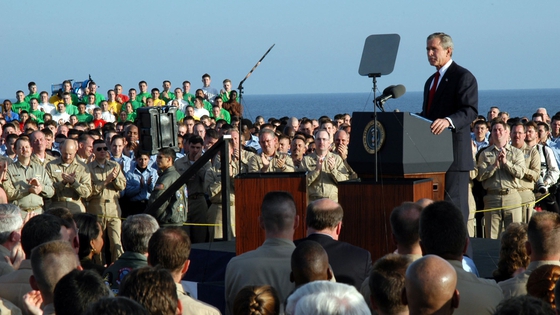
The George W. Bush administration gave three justifications prior to the United Sates invasion of Iraq in March 2003: Iraqi President Saddam Hussein possessed weapons of mass destruction; the Iraqi regime had connections to Al-Qaeda; and the regime’s massive violation of human rights was put forward to win the public opinion and to justify the war.[1] Shortly after the invasion, these justifications were questioned by the US public, policymakers, academics, and the international community. Even prior to the invasion, doubts concerning the intelligence on Iraq and the legality of such a war surfaced. Hence, the questions linger: why did the United States invade Iraq in 2003? Did the Bush administration justify a war and persuade public opinion on doubtful and uncertain intelligence? Did the Bush administration engage in a preemptive invasion of Iraq after 9/11 to counter terrorism?
The invasion of Iraq in 2003 has been deeply controversial and has led to an intense academic debate. The credibility of the justifications declared by the Bush administration has been questioned. Were the declared justifications for the invasion fabricated? Did the Bush administration initiate the war mainly to pursue various undeclared motives? The declared motives, as put forward by the administration, were Iraq’s possession of weapons of mass destruction (WMD), Iraq’s connections to Al-Qaeda and Saddam's violations of human rights. The undeclared motives, as emphasized through extensive scholarship and political debate, were the continuity of an unfinished first Gulf War, oil interests, solidifying Israel’s position in the Middle East, and US regional hegemony in the Middle East.[2] This article seeks to explain the declared justifications for the 2003 Iraqi invasion by the Bush administration.
The invasion of Iraq in 2003 was multidimensional and driven by both declared and undeclared motives. Proponents of the war argue that the invasion was a necessity in the post 9/11 era of stateless terrorism to ensure world peace and stability. As articulated by professor of public policy, Robert Kaufman: “for some threats if you wait too long it’s like cancer”.[3] In other words, terrorism must be countered immediately. Opponents of the war, however, emphasize alternative motives for the invasion, as Washington’s justifications have continuously been exposed as fabrications ever since the war. Opponents highlight that Iraq specialists and weapon inspectors clarified that Iraq possessed no serious WMD and was in no position to threaten the US and have thus labeled the war as “an unnecessary war”.[4] Professor of Peace and World Politics Studies, Michael Klare, for instance, has argued that the US would not have pursued such an extreme act without very powerful motives, and has emphasized that oil hegemony had long been the most prominent motive for US military involvement in the Middle East.[5]
Washington in favor of Iraq
With the fall of the Shah in 1979 and the Islamic revolution, Iran had become Washington’s prime threat to the region’s stability.[6] Therefore, since 1979, US administrations have sought to solidify and maintain US hegemony in the region. Primarily to stabilize the international oil system that was destabilized by the fall of shah.[7] The Soviet invasion of Afghanistan the same year had further pushed the US to lean towards Iraq to contain both the Islamic revolution and Soviet expansionism. Additionally, in the 1970s, Iraq had advanced both economically and strategically due to its vast oil resources. Thus, Iraq’s leaders sought to transform it into a dominant regional military force. Iraq’s steady growth in the 1970s culminated in its war against Iran in 1980 and the invasion of Kuwait in 1990.[8] Despite humiliating defeats in both wars, Baghdad upheld its hostility towards its neighbors and was thereby a major international dilemma for the US by the end of the 1980s.
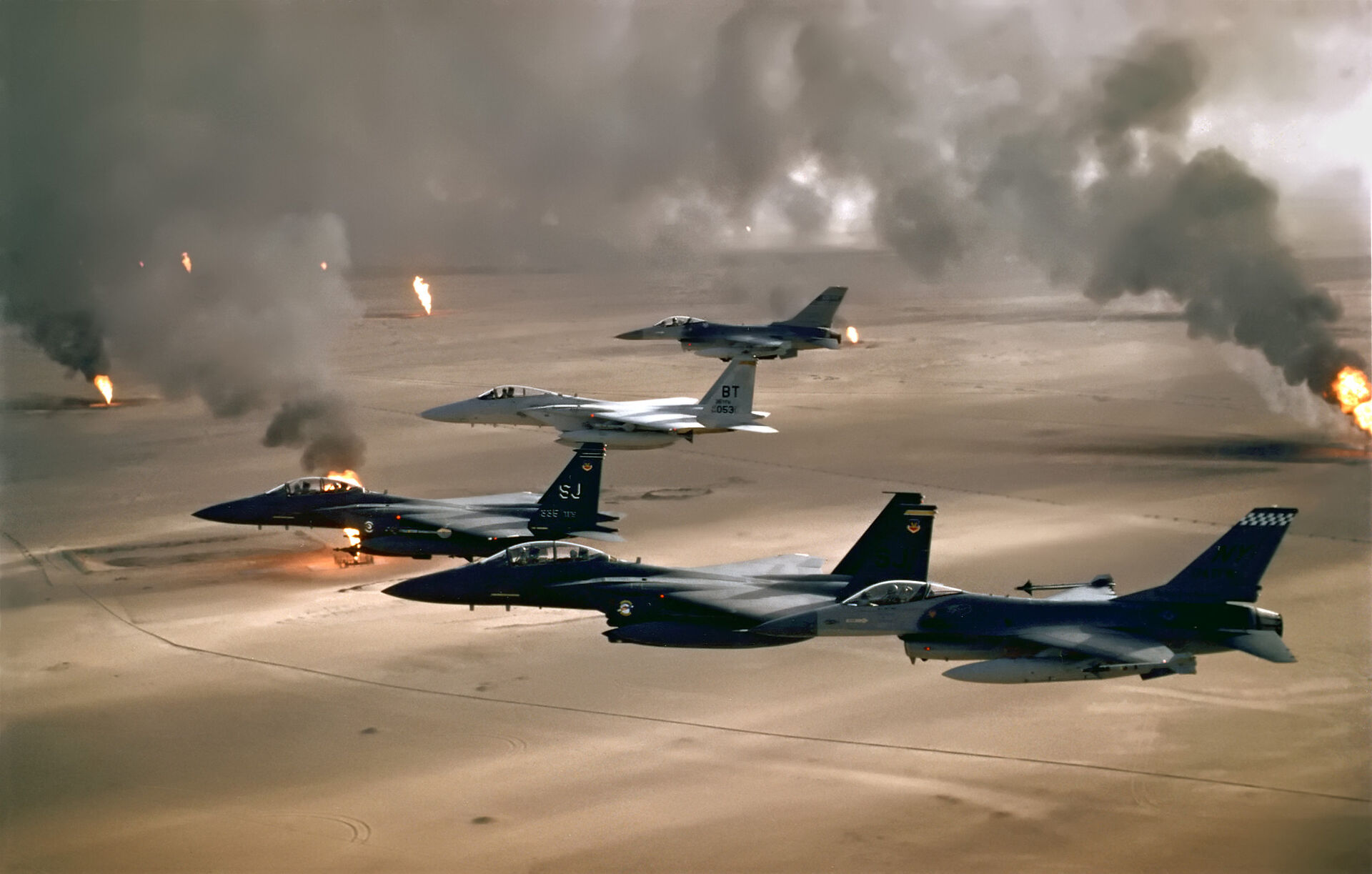
After the collapse of the Soviet Union in 1991, multilateralism had become “optional” for the US.[9] With no major powers to restrict US ambitions, international institutions such as the United Nations became a nuisance as they required negotiations and cooperation.[10] Hence, Washington increasingly turned towards unilateralism in the post-Soviet world order. The Middle East’s rogue regimes, such as Iraq, replaced the Soviet Union as the prime US. foe.[11] The containment of rogue regimes and preventing them from dominating important geographical regions became vital for the US. in the post-Soviet era.[12] Few other regions were more valuable than the Middle East, due to its gigantic oil reserves. It was vital for the US. to control these oil reserves to ensure universal access to Middle Eastern energy supplies and to hinder rogue regimes’ leeway to profit on such resources and gain military supremacy and threaten US regional hegemony in the region.[13]
Few other regions were more valuable than the Middle East, due to its gigantic oil reserves.
In the 1990s, under President George H. W. Bush, Washington considered a strong Iraq as the best way to contain Iran.[14] Additionally, Washington was optimistic that Iraq would promote regional stability by recognizing the State of Israel. However, Iraq had revealed no such intentions and continued to improve its military. Moreover, Iraq’s President Saddam Hussein “vocally denounced both the United States, which he accused of conducting a policy of occupation in the Middle East, and Israel, which he threatened to wipe off the map. The invasion of Kuwait was a turning point in US-Iraqi relations because it revealed how a potential hegemonic Iraq could seek regional dominance, take control over the region’s oil reserves, and thereby threaten US regional supremacy.[15] Therefore, after the Kuwait invasion, Washington decided that Saddam had to go. How exactly that was to be achieved, was yet not clear. Washington initially leaned towards a multilateral approach through the United Nations to secure legitimacy for a regime change in Iraq – this approach was dismissed by the administration of George W. Bush a decade later.[16]
The George W. Bush Administration was a Prerequisite for the Invasion of Iraq in 2003
During the administration of George W. Bush, the goal to preserve US hegemony in the Middle East was combined with two new elements that increased US intolerance of Saddam. Firstly, the administration itself, was the first since 1945 to fully represent the ideology of the neo-conservatives and leaned heavily on unilateralism and militarism.[17] Secondly, the events of 9/11 drove the administration to fully utilize its worldview and create a domestic environment that supported it.[18] Professor of International Relations, Raymond Hinnebusch explains that this administration brought together “a coalition of officials with great private influence, but with limited public image and accountability”, who projected the war and “strenuously propagated with weapons of mass deception”.[19]
“Arch conservative” Richard “Dick” Cheney was appointed vice-president – and his ideology is summed up by his colleague Robert Hartmann in this manner: “whenever his private ideology was exposed, he appeared somewhat to the right of [Gerald] Ford, [Donald] Rumsfeld, or for the matter, Ghengis Khan”.[20] Cheney’s ideological companion, Donald Rumsfeld was appointed Secretary of Defence. Accordingly, Cheney and Rumsfeld filled the Office of Vice-President and the Department of Defence with ideological fellow-minds. In total, seventeen members of “The Project for the New American Century” thinktank, who in 1998 signed a letter to Bill Clinton and called for a regime change in Iraq to promote democracy, took up key positions in the administration of George W. Bush.[21]
Hinnebusch further explains that the war of 2003 was on nobody’s agenda, “except of the coalition of neo-conservative extremists the Bush administration brought to power” and argues that the US would not have invaded Iraq under a different administration even though Iraq had been a problem for the Washington long before the Bush administration came to power.[22]
Moderates of the administration, such as Secretary of State Colin Powell and Deputy Secretary of State Richard Armitage were “kept carefully in check by the conservatives”, and quickly became isolated within the administration.[23] This made the position of National Security Advisor, Condoleezza Rice, crucial to ensure effective and cohesive decision-making. However, Rice proved to be highly ineffectual in her position. She was unable to ensure orderly policymaking, and former US diplomat, Richard Armitage even stated that “there was never any policy process...There was never one from the start”.[24] Still, the ultimate failure of the policy process lies not with Rice but with Bush, who failed to recognize the necessity of a cohesive decision-making process. Because even though the president was intelligent, he was intellectually incurious and failed to recognize the limitations of his expectations, so when he made up his mind, he rarely reconsidered. Thus, there was no comprehensive debate on the outcomes of the war against Iraq and evidence that opposed the war was neglected. Once the president had decided that Saddam had to go, it was the end of the discussion.[25]
Humanitarian Justification for the Invasion
The US contributed to Saddam’s aggression during the Iran-Iraq war, by allowing him to gather massive quantities of arms and military technology throughout the 1970s and 1980s.[26] Some scholars have argued that the invasion was initially a benign US intention to remove a dictatorship and to institute democracy in Iraq to secure the Iraqi people and the world.[27] Therefore, they view the administration not as a coalition of extremists, but as well-wishers of the Iraqi people and peace promoters. This argument has, however, been dismissed by most scholars. Because Washington had favored Iraq during the Iran-Iraq war despite Iraq’s employment of chemical weapons on its own people - the Kurds, who were accused of plotting with Iran during the Iran-Iraq war and due to Washington’s lack of concern about the Iraqi people’s suffering and the destruction of Iraqi institutions. Additionally, the US had supported Iraq despite its violation of human rights in the 1980s – this historical context went unacknowledged within the Bush administration.[28]
The administration also believed that after the invasion, Iraqi institutions and police forces would stay intact, and only a new leadership would be required. They viewed Iraq as a competent state with an intellectually advanced society and a significant professional middle class - severely undermining the instability and chaos that accompanies fall of governmental institutions even in intellectually advanced societies.[29] Post-war planning was neglected because most administration officials opposed nation-building in faraway lands - that was a task for the locals. For them, the US objective was to “maintain international order and crush challenges to American hegemony, not to tidy up afterwards” – and no one cared less about post-war Iraq than Donald Rumsfeld.[30] Regarding the Iraq War Rumsfeld commented that “Iraq belongs to the Iraqis and we do not aspire to own it or run it” and that “there should be no major US involvement and the locals should manage things themselves”.[31]
The Office of Reconstruction and Humanitarian Assistance (ORHA) under the Department of Defence (DOD) was established only two months before the invasion, and very little reconstruction-planning took place before the establishment of ORHA. Additionally, ORHA’s staff consisted of people assigned positions outside of their area of expertise and with limited Middle East knowledge. Hence, no serious thought was given to the post-war situation in Iraq. OHRA concluded that it was established too late and did not have the resources or competence to maintain order in the post-war Iraq society. General Jay Garner, head of OHRA, warned that “we risk letting the country descend into civil unrest whose magnitude may defeat our national strategy of a stable new Iraq”.[32] Thus, the claim that the administration invaded Iraq to save the Iraqi people is baseless.
The claim that the administration invaded Iraq to save the Iraqi people is baseless.
9/11 and Stateless Terrorism
Within Washington, attention towards Iraq had shifted immediately after the 9/11 attacks. Steven Hurst has argued that “the war was already coming when the public began hearing about it”.[33] Secretary of Defense, Donald Rumsfeld even suggested the invasion of Iraq in addition to or instead of the invasion of Afghanistan.[34] For Rumsfeld, Saddam’s Iraq was a prime source of future state-driven terrorism. Hence, the administration agreed that even if Saddam Hussein was not involved in 9/11, he was likely to be involved the next time and that alone was enough for the administration to justify the war.[35] Rumsfeld argued that 9/11 had exposed those rogue states, such as Iraq, that had discovered a way to provide WMD to terrorist groups and conceal their responsibility in terror-attacks. Rumsfeld further commented that if rogue regimes “believe they can conceal their responsibility for an attack, then they would likely not be deterred”.[36] They could arm terrorists to prevent a US response to their regional ambitions.[37] Therefore, 9/11 had made it possible for the Bush administration to stress and combine the threat posed by rogue states, WMD, and terrorism into a single threat to justify a regime change in Iraq through an invasion.[38]
Before 9/11 Washington had maintained the policy of containment and deterrence in Iraq. But after 9/11, a regime change in Iraq was viewed as a necessity to counter-terrorism ensure political stability globally. As explained by the president himself: “Prior to September 11, we were discussing smart sanctions . . . After September 11, the doctrine of containment just doesn’t hold any water . . . My vision shifted dramatically after September 11, because I now realize the stakes, I realize the world has changed”.[39] Thus, the administration discredited the policy of containment and deterrence after the 9/11 attacks and initiated the policy regime change in Iraq.
Saddam and deterrence
The administration emphasized that Saddam Hussein was “reckless, ruthless, and not fully rational”, due to his actions in Iran and Kuwait.[40] Moreover, there was a consensus within the administration that Iraq had not fully disarmed after the Gulf War and intended to arm terrorist groups.[41] Therefore, the administration sincerely believed that a man as irrational as Saddam, “when mixed with nuclear weapons, was too unpredictable to be prevented from threatening the United States”.[42] The administration agreed that Saddam had to be removed as he was an imminent threat to the US and its allies. Proponents of the war within the administration even admitted that the war could be costly, lead to lengthy US. occupation, and complicate US relations with other countries.[43] But these concerns were overshadowed by the combination of Saddam’s WMD capacities being a pending threat and that was enough for the administration to justify the war.[44] Even opponents of the war within the administration, such as Colin Powell agreed that the policy of deterrence would not work in Iraq.[45] Yet, unlike proponents of the war, opponents insisted on using the fear of terrorism after 9/11 to reinitiate weapons inspections in Iraq and eliminate any remaining or new arms-resources.[46] Still, the baseline for both proponents and opponents of the war was the same: Saddam’s WMD capacities could not be tolerated, because he was too irrational and could not be deterred nor contained.
Scholars, however, have argued that Saddam’s political history revealed that he could be deterred - just as with the Soviet Union during the cold war. Saddam’s goal both in Iran and Kuwait was to strengthen Iraq, and his willingness to initiate war to achieve so revealed that he was vulnerable and strategic, and not irrational.[47] Both times he initiated war to counter Iraq’s vulnerability, and because he assumed that Iran and Kuwait would be easy targets before Iran grew any stronger.[48] Historian Efraim Karsh claims that the Iran War began “because the weaker state, Iraq, attempted to resist the hegemonic aspirations of its stronger neighbor, Iran to reshape the regional status quo according to its own image”.[49] Additionally, the war against Iran was no ruthless act, “it was an opportunistic response to a significant threat” and thus a defensive war – or in the least an preemptive one.[50] Iraq had gone to war against Iran not to exploit the turmoil in Iran after the fall of shah, but to protect itself from becoming a target of Iran’s Islamic revolution – which aimed to spread throughout the Islamic world, starting with Iraq.[51] Similarly, Saddam launched a war on Kuwait in 1990 to deal with Iraq’s continued vulnerability. Iraq’s economy suffered badly after the eight-year long Iran-Iraq war. Kuwait had refused to loan Iraq ten billion for reparations, and the Iraqi debts from the Iran-Iraq war was contributing to Iraq’s difficulties. Moreover, Iraq argued that Kuwait was hyper-producing oil, which drove down world oil prices and reduced Iraq’s oil incomes. Saddam believed that Iraq was entitled to international assistance because it had protected Kuwait and other Gulf states from Iranian expansionism and initiated a war only when diplomacy had failed.[52]
Moreover, Saddam had approached the US before sending Iraqi troops into Kuwait, to see how it would react.[53] April Glapsie, US ambassador to Iraq, had in that regard told Saddam: “[W]e have no opinion on the Arab-Arab conflicts, like your border disagreement with Kuwait”.[54] Similarly, the US Department of State had earlier told Saddam that the US had “no special defense or security commitments to Kuwait”.[55] Thereby, Washington unintentionally gave Iraq a green light to launch war against Kuwait in 1990.[56] Similarly, the war against Iran was favored by the US because Washington was positive that a strong Iraq was the best way to contain the Islamic revolution and provided Iraq with arms and military information. Thus, Saddam’s decisions to initiate these two wars were neither irrational nor reckless – deterrence did not fail; deterrence was never tried.[57]
Saddam and WMD
Scholarly research has criticized the administration's claim that the Iraq invasion was about terrorism after 9/11, and not WMD and hegemony. Neo-conservatives had been obsessed with WMD-armed rogue states for a decade before 9/11 and saw Iraq as a prime example of a state that could be fixed through regime change. Also, the administration shared the 1990s belief that Iraq had not fully disarmed after the Kuwait War. Deputy Secretary of Defence Paul Wolfowitz stated that it was “the one issue everyone could agree on”.[58] Moreover, the administration would not have based its entire propaganda strategy on WMD had they not sincerely believed that they existed. Hence, “the idea that [the] Iraq War was not about WMD flies in the face of both evidence and logic”.[59] Regarding terrorism, the administration certainly became obsessed with Islamic terrorism with WMD at its disposal after 9/11. Still, this did not change the original rationale for the Iraq invasion. In 2002, Dick Cheney stated that Iraq with WMD “could then be expected to seek domination of the entire Middle East, take control of a great portion of the world’s energy supplies, directly threaten America’s friends throughout the region and subject the United States or any other nation to nuclear blackmail”.[60] Therefore, the original rationale for a regime change in Iraq was to preserve US hegemony – 9/11 only fast-tracked the procedure.
Therefore, the original rationale for a regime change in Iraq was to preserve US hegemony – 9/11 only fast-tracked the procedure.
Fabrications
The George W. Bush administration started a massive campaign to secure public opinion in favor of the war. Former security adviser Brent Scowcroft argued in 2002 that the threat posed by Saddam was being exaggerated. Scowcroft clarified that threatening the US with WMD would be suicidal, and Saddam was by no means suicidal, he was rather a “power-hungry survivor”.[61] Furthermore, Scowcroft even warned that a war on Iraq would ruin international support for US foreign policy.[62] Former Secretaries of States, James Baker and Lawrence Eagleburger also advised the administration to avoid unilateralism and seek the return of weapons inspections through the UN and only “consider a war if such a return was refused”.[63] Such criticism provoked the administration to propagandize the threat posed by Iraq, and aggressively exaggerate that Iraq already had WMD, would shortly have nuclear weapons, was connected to Al-Qaeda, and involved in the 9/11 attacks.[64] None of these claims turned out to be true and have ever since led researchers to question the administration’s march to war in 2003.
Post war investigations also revealed that the intelligence on Iraq had seriously failed and that the US Intelligence Community (IC) overestimated the threat posed by Saddam. However, the Bush administration was not alone in overvaluing the Iraq-threat. The Carnegie Endowment for International Peace revealed that most national and international experts and officials sincerely believed that Iraq had WMD research programs, hidden chemical and biological weapons, and sought to develop nuclear weapons.[65] Still, the Carnegie Endowment concluded that the “administration officials systematically misrepresented the threat from Iraq’s WMD and ballistic missile programs”.[66] However, the greatest misrepresentation occurred strictly within the areas that were most crucial for the public case of the war: nuclear weapons and ties to Al-Qaeda. In 2002 Cheney publicly claimed that “the evidence indicates Iraq is reconstituting its nuclear weapons programs”.[67] In 2003 Cheney furthered his concern by stating that “we believe that he [Saddam] has, in fact, reconstituted nuclear weapons.[68]
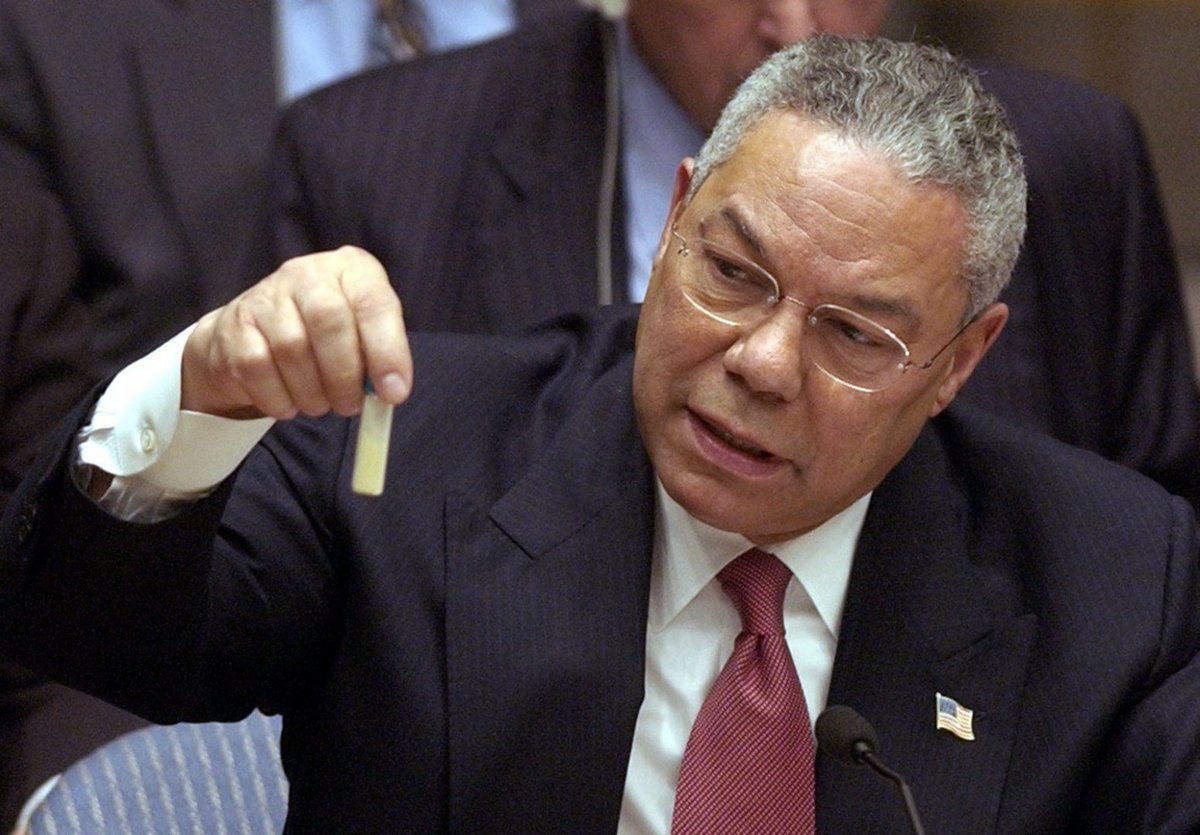
The administration continuously emphasized two pieces of evidence to support their claims. Firstly, the administration emphasized an Iraqi order of aluminum tubes and insisted that they were to produce nuclear weapons. Secondly, they emphasized on a report that claimed that Iraq had sought to buy “yellowcake” uranium ore from Niger. Both claims were uncertain at the time, and Hurst claims that the National Intelligence Agency regarding the “yellowcake” claim stated that “we do not know the status of this agreement” and “we cannot confirm whether Iraq succeeded in acquiring uranium and/or yellowcake”.[69] Regarding aluminum tubes both the Bureau of Intelligence and Research (INR) and the Department of Energy (DOE) argued that they were for rockets and not for nuclear weapon production.[70]Another significant misrepresentation of intelligence by the administration was regarding Iraq’s connections to Al-Qaeda. In Bush’s Cincinnati speech, he stated that “we know that Iraq and Al-Qaeda have high-level contacts that go back a decade . . . We’ve learned that Iraq has trained Al-Qaeda members in bomb-making, poison, and deadly gasses”.[71] Hence, the administration stressed that Iraq was involved in 9/11. The CIA, on the other hand, stated that “we have no credible information that Baghdad was complicit in the attacks”.[72]
The administration not only misrepresented the intelligence, but also “manipulated the intelligence process in an effort to produce evidence supporting the case for war”.[73] It ordered the IC to specifically focus on the limited evidence that supported the war. Moreover, in the summer of 2002, Dick Cheney, pressured analysts to find evidence that supported the administration’s decision on war. Deputy-Director of CIA Jami Miscik even threatened to resign if she were to rewrite another report on Iraqi connections to Al-Qaeda on the demands from the Office of Vice-President.[74] Moreover, the administration created a parallel intelligence section, Policy Counterterrorism Advisory Group (CAG) under the Department of Defence (DOD). However, the notion that the administration “simply knew that their claims were untrue but made them anyway” is not credible. This is because a study of the available evidence has revealed that there was no discussion within the administration that considered that Iraq might not have WMD. Instead, “it was precisely the absolute, almost theological, certainty that Saddam did have active WMD programs that were the primary cause of the administration’s actions”.[75]
This combination of the administration's absolute certainty that Iraq possessed WMD and distrust in IC's ability to recognize threats posed by hostile regimes, led to the administration’s “faith-based” approach to intelligence: “we know the answers, give us the evidence to support those answers”.[76] Any uncertainty by IC regarding Iraq’s WMD program was rejected because the administration was positive that Saddam had WMD and was an imminent threat to the US. Therefore, for the Bush administration, after the 9/11 attacks, “exaggerating the evidence in order to sell the war was entirely justified”.[77]
Conclusion
The Middle Eastern rogue regimes became the foremost US foe in the post-Soviet world order. It was vital for the US to contain Middle Eastern autocracies and prevent them from gaining supremacy over the region’s energy supplies and threaten US regional hegemony. Scholars have pointed out oil, hegemony, and the defense of Israel as some of the key drivers for US military involvement in the Middle East. A regime-change in Saddam Hussein's Iraq had been on the US agenda since the 1990s due to Saddam’s hostility in Iran and Kuwait. For Washington Saddam’s actions had revealed that he was far too reckless to make political and military decisions and had to be removed. Washington initially sought a multilateral approach through the United Nations to secure legitimacy for a regime change in Iraq. After the 9/11 attacks this approach was dismissed by the administration of George W. Bush.
Scholars view the combination of the George W. Bush administration and the events of 9/11 as a prerequisite for the Iraq War of 2003. The administration itself, fully represented the ideology of the republican right and leaned heavily on unilateralism and militarism. Also, there was a widespread consensus within the administration that Iraq had not been adequately disarmed after the Persian Gulf War, and actively sought WMD. Hence, the Bush administration persuaded the public opinion based on doubtful and uncertain intelligence because it sincerely believed that Saddam Hussein possessed WMD and was an imminent threat to the US. The administration also believed that even if Iraq was not involved in the 9/11 attacks, it was likely to be involved the next time. This was enough for the administration to exaggerate the threat posed by Saddam to justify a preemptive invasion of Iraq to counter-terrorism in the post 9/11-era of stateless terrorism. Additionally, the administration agreed that rogue regimes with WMD could supply terrorists and thus, conceal their responsibility in terror-attacks. Therefore, for the Bush administration, 9/11 had proved that rogue regimes could not be contained and could not be deterred. Hence, the events of 9/11 made it possible for the Bush administration to combine and stress the threat posed by rogue states, WMD and terrorism into a single threat to justify a preemptive invasion of Iraq to counter-terrorism.
Bibliography:
Primary Sources:
President George W. Bush Declares War on Iraq, Washington, Thursday, March 20, 2003. CNN – Full transcript of the president’s address: https://edition.cnn.com/2003/US/03/19/sprj.irq.int.bush.transcript/
Donald H. Rumsfeld, Testimony as Delivered by Secretary of Defense Donald H. Rumsfeld before the House and Senate Armed Services Committees regarding Iraq’, Rayburn House Office Building, Washington, D.C., September 18-19, 2002.
http://www.sscnet.ucla.edu/polisci/faculty/trachtenberg/useur/rumsfeld180902.html
Richard B. Cheney speaks at VFW 103rd National Convention, 26th August 2002.
https://georgewbush-whitehouse.archives.gov/news/releases/2002/08/20020826.html
Press conference: Prime Minister Tony Blair and President George Bush, 31 January 2003.
https://georgewbush-whitehouse.archives.gov/news/releases/2003/01/20030131-23.html
Richard B. Cheney, ‘Vice-President speaks at VFW 103RD National Convention’, 26 August 2002
https://georgewbushwhitehouse.archives.gov/news/releases/2002/08/20020826.html.
George W. Bush comments on Iraq in Cincinnati, Ohio, 7th October 2002.
https://georgewbush-whitehouse.archives.gov/news/releases/2002/10/20021007-8.html
Excerpts of transcript of meeting between Saddam Hussein and US Ambassador April Glapsie, 25 July 1990, New York Times.
https://www.nytimes.com/1990/09/23/world/confrontation-in-the-gulf-excerpts-from-iraqi-document-on-meeting-with-us-envoy.html HIS3090 Candidate no: 3560 Spring 2020
Secondary Sources:
Hurst, Steven, The United States and Iraq Since 1979 – Oil, Hegemony, and War, Edinburgh: Edinburg University Press, 2009. ISBN 978 0 7486 2768 4.
Frederic Bozo, A History of the Iraq Crisis – France, the United States and Iraq, 1991 -2003, Washington, D.C, Woodrow Wilson Center Press, 2016. ISBN 978 0 2317 0444 1.
Hinnebusch, Raymond, “The US Invasion of Iraq: Explanations and Implications” 209-229, Critique: Critical Middle Eastern Studies, 01 Oct 2007. https://doi.org/10.1080/10669920701616443
Jervis, Robert, “Understanding the Bush Doctrine”, Political Science Quarterly, Vol. 118, No. 3, 1st September 2003. The Academy of Political Science: https://www.jstor.org/stable/30035780
Robert Kaufman, “In Defense if the Bush Doctrine”, Cable-Satellite Public Affairs Network – Video: July 15, 2011. https://www.c-span.org/video/?300700-2/in-defense-bush-doctrine
John J. Mearsheimer, Stephen M. Walt. “An Unnecessary War”. Foreign Policy November 3, 2009, 9:06 PM. https://foreignpolicy.com/2009/11/03/an-unnecessary-war-2/
John J. Mearsheimer and Stephen M. Walt, “Can Saddam be Contained History Says Yes?”, Foreign Policy Bulletin, Cambridge Vol. 14, Issue 1, 2003. https://www.researchgate.net/publication/248623168_Can_Saddam_be_Contained_History_Says_Yes
Tofiq Kaka Amin, Zana. Why did the United States lead an invasion of Iraq in 2003? Academic Research Journals. University of Raparin- Department of Law. 18 December 2014. https://www.semanticscholar.org/paper/Why-did-the-United-States-lead-an-invasion-of-Iraq-Tofiq-Amin/7747b8763c6a4e7e749c8e6a88f3a2c21b1792c0
Fallows, James. “Blind into Baghdad”. The Atlantic, January/February 2004 Issue. https://www.theatlantic.com/magazine/archive/2004/01/blind-into-baghdad/302860/
Fallows, James. “Blind into Baghdad”. The Atlantic, January/February 2004 Issue. https://www.theatlantic.com/magazine/archive/2004/01/blind-into-baghdad/302860/
Footnotes:
[1] President George W. Bush Declares War on Iraq, Washington, Thursday, March 20, 2003. CNN – Full transcript of the president’s address: https://edition.cnn.com/2003/US/03/19/sprj.irq.int.bush.transcript/.
[2] Raymond Hinnebusch, “The US Invasion of Iraq: Explanations and Implications”, Critique 16, no. 3 (2007), 215.
[3] Robert Kaufman, In Defense of the Bush Doctrine (Lexington: University Press of Kentucky, 2009)
[4] John J. Mearsheimer, Stephen M. Walt, “An unnecessary war” Foreign Policy 134, no. 134 (2003), 50-59.
[5] Hinnebusch, “The US Invasion of Iraq”, 212.
[6] Steven Hurst, The United States and Iraq Since 1979, (Edinburgh, Edinburgh University Press, 2009), 153.
[7] Frederic Bozo, A History of the Iraq Crisis, (Washington D.C, Woodrow Wilson Center Press, 2016), 22.
[8] Bozo, A History of the Iraq Crisis, 22.
[9] Hurst, The United States and Iraq Since 1979, 115.
[10] Bozo, A History of the Iraq Crisis, 24.
[11] Bozo, A History of the Iraq Crisis, 25.
[12] Hurst, The United States and Iraq Since 1979, 118.
[13] Hinnebusch, “The US Invasion of Iraq”, 212.
[14] Hinnebusch, “The US Invasion of Iraq”, 221.
[15] Hurst, The United States and Iraq Since 1979, 162.
[16] Hurst, The United States and Iraq Since 1979, 170-171.
[17] Hurst, The United States and Iraq Since 1979, 153.
[18] Hurst, The United States and Iraq Since 1979, 154.
[19] Hinnebusch, “The US Invasion of Iraq”, 211.
[20] Hurst, The United States and Iraq Since 1979, 176.
[21] Hurst, The United States and Iraq Since 1979, 156.
[22] Hinnebusch, “The US Invasion of Iraq”, 210.
[23] Hinnebusch, “The US Invasion of Iraq”, 224.
[24] Hurst, The United States and Iraq Since 1979, 20.
[25] Hurst, The United States and Iraq Since 1979, 157.
[26] Bozo, A History of the Iraq Crisis, 24.
[27] Hinnebusch, “The US Invasion of Iraq”, 210.
[28] See Hinnebusch, p. 210; Bozo, p. 23; Hurst, p. 47, 172 – 173.
[29] Bozo, A History of the Iraq Crisis, 23.
[30] Bozo, A History of the Iraq Crisis, 23.
[31] Hurst, The United States and Iraq Since 1979, 173.
[32] Hurst, The United States and Iraq Since 1979, 173.
[33] James Fallows, “Blind into Baghdad”
[34] Hurst, The United States and Iraq Since 1979, 160.
[35] Hurst, The United States and Iraq Since 1979, 161.
[36] Prepared testimony of US Secretary of Defence Donald H. Rumsfeld, 18-19 September 2002.
[37] Hurst, The United States and Iraq Since 1979, p. 163.
[38] Hurst, The United States and Iraq Since 1979, p. 160.
[39] ‘Press conference: Prime Minister Tony Blair and President George Bush’, 31 January 2003.
[40] Mearsheimer & Walt, “An Unnecessary War”. 50-59.
[41] Hurst, The United States and Iraq Since 1979, 168-169.
[42] Mearsheimer & Walt, “An Unnecessary War”, 50-59
[43] Fallows, “Blind into Baghdad”.
[44] Hurst, The United States and Iraq Since 1979, p. 169.
[45] Mearsheimer, Walt, “An Unnecessary War”. 50-59
[46] Ibid.
[47] Ibid.
[48] Ibid.
[49] John J. Mearsheimer and Stephen M. Walt, “Can Saddam be Contained?”, Foreign Policy Bulletin 14. no. 14 (2003), 4.
[50] Mearsheimer & Walt, “An Unnecessary War”, 50-59
[51] Ibid.
[52] Mearsheimer & Walt, “Can Saddam be Contained”, 5-7.
[53] Hurst, The United States and Iraq Since 1979, 89-90.
[54] Hurst, The United Stated and Iraq Since 1979, 90; Excerpts of transcript of meeting between Saddam Hussein and US Ambassador April Glapsie, New York Times.
[55] Mearsheimer & Walt, “An Unnecessary War”. 50-59
[56] Ibid.
[57] Ibid.
[58] Hurst, The United States and Iraq Since 1979, p. 192.
[59] Hurst, The United States and Iraq Since 1979, p. 162.
[60] Richard B. Cheney speaks at VFW 103rd National Convention, 26th August 2002.
[61] Hurst, The United States and Iraq Since 1979, p. 166
[62] Ibid.
[63] Ibid.
[64] Ibid.
[65] Ibid.
[66] Ibid.
[67] Ibid.
[68] Ibid.
[69] Ibid.
[70] Ibid.
[71] George W. Bush, comments on Iraq in Cincinnati, Ohio, 7th October 2002; Hurst, The United Stated and Iraq Since 1979, p. 168.
[72] Hurst, The United States and Iraq Since 1979, p. 168.
[73] Ibid.
[74] Ibid.
[75] Ibid.
[76] Ibid.
[77] Ibid.